

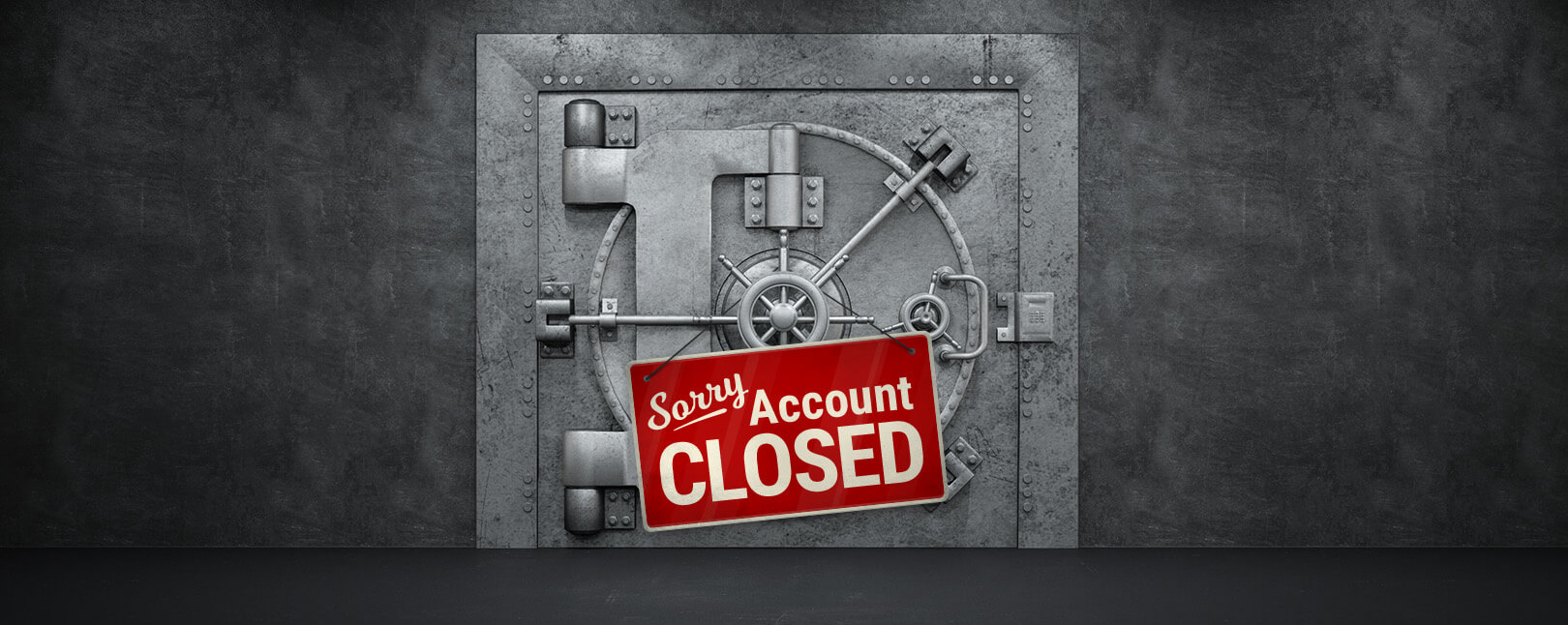
Closed Merchant Account Due to Fraud or Chargebacks? Don't Worry—You Have Options.
If your acquiring bank has just closed your merchant account, or if you suspect that your account is in imminent danger, you have to act fast. What should you do?! What’s the first step to take toward recovering from a disaster like this?
It’s true that a terminated processing agreement and closed merchant account will carry severe long-term ramifications. There are several things you need to know, however.
Depending on how this is handled, seeing your merchant account closed could mean a slight shift in how your business operates, or it could mean total collapse. So, take a deep breath, tread carefully, and read on.
Recommended reading
- High-Risk Credit Card Processing: The Best Providers of 2024
- What is the Amex Fraud Full Recourse Program?
- High-Risk Merchant Accounts: The Best Providers of 2024
- How the Terminated Merchant File Can Affect Your Business
- Merchant Account Reserves: What You Need to Know in 2024
- Visa Dispute Monitoring Program: What is the VDMP?
A Terminated Merchant Account is Serious
An acquirer assumes a degree of risk every time they process a payment on any merchant’s behalf. For instance, there’s always the possibility that:
- The merchant could go out of business.
- Chargeback liabilities could exceed the merchant’s account balance.
- The merchant could engage in shady business practices.
Acquirers have a primary responsibility to look after their own assets. If the bank suspects that your account poses a potential risk for any reason, they’re likely to terminate their agreement with you and close the account.
If that happens, any funds in your account might be frozen and inaccessible to you until the bank resolves any outstanding debits and disputes. You’d also be unable to process any new transactions until you secure a new account. This could be hard, as other processors and financial institutions may refuse to do business with you. Service providers that are still willing to take you on may charge exorbitant fees and impose restrictions on your activity to offset the perceived risk.
In most cases, a closed merchant account means that your business is in serious danger. If you don’t act fast, you may lose everything you’ve worked for.
Why is My Merchant Account Closed?
Like we mentioned, your acquirer may close your account if they feel that it poses a risk to their business.
There are specific reason codes that outline why a merchant account could be closed. We’ll examine these in more detail later. For now, we’ll say that forcibly closed merchant accounts usually happens for one of three reasons:
The majority of canceled merchant accounts are caused by excessive chargeback levels. The networks usually require merchants to keep their chargeback ratio below a specific, predetermined threshold. However, it’s probable that a merchant account will be terminated long before the card networks’ thresholds have been breached.
Additionally, you can still twist on the hook for chargebacks after your account has been closed or canceled. You read that right. Just because your account is shut, doesn’t mean you won’t receive chargebacks that were filed beforehand. Since the chargeback process takes a while to set in motion, you could still receive chargebacks for a few months after the date your merchant account closed.
How a Merchant Account Gets Closed: A 3-Stage Progression
In extreme cases, the bank may jump straight to canceling a merchant account. This would only happen as a way to try and cut off abuse that is presently in progress. In most cases, the bank will attempt a few other options before finally closing your account.
If your account is under review by your acquiring bank, the process will likely occur in three stages:
Stage #1 | Revenue Hold
Merchant account reserves are common practice for high-risk payment processing. Because of the increased risk level, acquirers withhold a portion of the merchant’s revenue to cover potential losses. The bank will use the reserve account to cover losses if the operating account doesn’t have sufficient funds.
The amount to be withheld will be laid out in the merchant agreement. Some banks will require a reserve upfront. For example, the merchant might be required to provide the equivalent of one to two months’ worth of anticipated sales. Or, a rolling reserve will hold back a percentage of sales each month.
Merchant account in danger? The experts are here to help.

Stage #2 | Account Freeze
Account holds and freezes are similar in some regards. But, while a hold is just a temporary measure, a freeze can be indefinite. It’s generally a sign that your account termination is imminent.
While an account freeze is in effect, you won’t be able to process any card transactions or transfer funds from the account. Also, any income you have pending won’t be deposited until the freeze is lifted.
Stage #3 | Account Termination
The final stage of the process is the absolute worst-case scenario. At this stage, your acquirer will inform you that your merchant account closed due to one of the three reasons outlined above.
Once a merchant account is terminated, your acquirer is required to add you to the MATCH List (sometimes called the “Terminated Merchant File”). This is a running log of merchants whose accounts have been closed by an acquirer and processor. Being MATCHed means you’ll be labeled as “high-risk.” This will make finding a processor that will work with you much more difficult.
What is the MATCH List?
Generally, while a closed merchant account isn’t a guaranteed trip to the MATCH list, it can happen if your account closure meets certain criteria:
| MATCH List Reason Code | Title | Explanation |
| Reason Code 01 | Account Data Compromise | Account data is stolen from the card-present merchant and used with other merchants |
| Reason Code 02 | Common Point of Purchase | Account data is stolen from the card-present merchant and used with other merchants |
| Reason Code 03 | Laundering | The merchant processed transactions that did not involve a bona fide cardholder |
| Reason Code 04 | Excessive Chargebacks | The merchant breached predetermined chargeback thresholds |
| Reason Code 05 | Excessive Fraud | The merchant breached predetermined fraud-to-sales dollar volume thresholds |
| Reason Code 06 | Currently unused | -- |
| Reason Code 07 | Fraud Conviction | One of the business's owners was convicted of criminal fraud |
| Reason Code 08 | Mastercard Questionable Merchant Audit Program | The merchant is labeled a “Questionable Merchant,” as determined by MasterCard guidelines |
| Reason Code 09 | Bankruptcy, Liquidation, Insolvency | The merchant is unable to discharge all financial obligations |
| Reason Code 10 | Violation of Standards | The merchant was in violation of one or more of the card network’s regulations |
| Reason Code 11 | Merchant Collusion | The merchant participated in fraudulent collusive activities |
| Reason Code 12 | PCI-DSS Noncompliance | The merchant wasn’t compliant with PCI-DSS requirements |
| Reason Code 13 | Illegal Transactions | The merchant processed illegal transactions |
| Reason Code 14 | Identity Theft | The business owner’s identity is in question |
You won’t necessarily be notified if you’ve been added to the MATCH list. Therefore, if your merchant account was terminated due to one of the reasons above, it would be in your best interest to contact your acquirer to get the details. Removal from the MATCH List is possible, but there are only two circumstances under which it might happen:
- The acquirer contacts Mastercard on your behalf and reports the original addition was made in error.
- You were added using MATCH list reason code 12 (PCI-DSS Non-Compliance), but have since become compliant.
No. If your account is closed or terminated, it’s not really the end of the world.
A closed merchant account will complicate matters considerably, but you can still find processors specializing in high-risk merchant accounts. However, you should know that high-risk processors tend to be more restrictive and can be significantly more expensive. Aside from this, it will be challenging to regain your former status once you're labeled a “high-risk” merchant.
Ultimately, having your account terminated is never a good look. Many financial institutions may refuse to do business with you, while those still willing to take you on may charge high fees to offset the added risk. Don’t despair, though: even with a closed merchant account, you can still keep on rolling…if you make the right moves in a timely manner.
8 Steps to Take After a Closed Merchant Account
A canceled merchant account is a serious setback. Still, it doesn’t necessarily need to be the death blow that kills the endeavor. Here’s what to do:
Step #1 | Ask Why the Termination Happened
You shouldn’t assume you understand the reasoning for the account cancellation. It’s important to know the absolute truth. Plus, you’ll need to provide a written statement from your previous acquirer when applying for a new merchant account.
Step #2 | See if the Account was MATCHed
The MATCH List is a database with information about businesses and owners whose merchant account has been canceled. The card networks require banks to report all terminated merchant accounts via the MATCH List.
Ensure the business has, in fact, been MATCHed. The application process for a new merchant account may be different for businesses that have been placed on the MATCH List.
Step #3 | Save Statements
You should have at least six months’ worth of processing statements. Before losing access to the acquirer’s online reporting system, you should double-check that you have all the necessary paperwork to get up and running with a new service provider as quickly as possible.
Step #4 | Start Looking for a New Acquirer
It’s possible to secure a new merchant account. You shouldn’t waste time contacting acquirers that refuse to do business with high-risk merchants, though. Many financial institutions will refuse to sign a business with a terminated merchant account.
You need to recognize the position you’re in, along with the new limitations resulting from it. Seek out a service provider that specializes in high-risk merchant accounts.
Step #5 | Be Honest & Forthcoming
Many merchants are tempted to make their situation seem better than it is. They assume this makes them more appealing to a prospective acquirer. In reality, it’s a bad tactic that will probably backfire (most likely in the form of increased rates).
The acquirer will learn of any past problems anyway. It’s best to acknowledge them upfront so as not to sacrifice the acquirer’s trust.
Step #6 | Stay Professional
It takes a long time to underwrite a high-risk account (much longer than a traditional account). Don’t try to rush the system. Relax. The acquirer probably dislikes the excess paperwork just as much as you do!
Step #7 | Be Compliant
Acquirers will scrutinize any new merchant, but will be especially cautious of those with a previously canceled merchant account. The bank will carefully monitor your activity to ensure the new account complies with the current merchant agreement.
As long as you remain compliant with all aspects of the merchant agreement, you shouldn’t have anything to worry about.
Step #8 | Preventing Chargebacks is Key
Remember the old adage: “Fool me once, shame on you. Fool me twice, shame on me.”
A terminated merchant account is evidence of insufficient chargeback management techniques. If you don’t seek help the second time around, you’re destined to repeat the same mistakes. So, if your account is in imminent danger of termination due to chargebacks, for instance, it’s imperative that you do whatever is necessary to fix the problem.
We recommend you contact Chargebacks911® as soon as possible. You’ll face numerous hurdles, including issuing refunds to customers, retrieving revenue, and managing future chargebacks. We can help, but in situations like these, you don’t have a moment to lose.
Chargebacks911 offers a guaranteed ROI. We’ll let you know if our services are a good fit for your business, and we can help you with your current predicament.
FAQs
What is a merchant account?
A merchant account is a line of credit extended to a merchant via an acquiring bank or processor that allows a merchant to accept credit and debit card payments, and also receive funds from each transaction. It is different from a depository account like a consumer checking or savings account in several regards.
Why would an acquirer close your merchant account?
A canceled merchant account usually results from one of three things: suspicious merchant activity, too many unauthorized transactions, or chargebacks.
What happens if your merchant account gets closed?
If your merchant account is closed, you will have to find processors specializing in high-risk merchant accounts to process payments. However, you should know that high-risk processors tend to be more restrictive and can be significantly more expensive. Aside from this, it will be challenging to regain your former status once you're labeled as “high risk.”
What is a revenue hold?
Merchant account reserves are common practice for high-risk payment processing. Because of the increased risk level, acquirers withhold a portion of the merchant’s revenue to cover potential losses. The bank will use the reserve account to cover losses if the operating account doesn’t have sufficient funds.
What is an account freeze?
While an account freeze is in effect, you won’t be able to process credit or debit card transactions. Any income you have earned in the meantime won’t be deposited until the freeze is lifted. This is assuming the account is not terminated, of course.
Can you still get chargebacks if your account is frozen/closed?
Yes. You can still be held responsible for chargebacks after your account has been closed or terminated. Just because your account is closed doesn’t mean you won’t receive chargebacks filed beforehand.
Since the chargeback process takes a while to set in motion, you could still receive chargebacks for a few months after the date your merchant account closed.