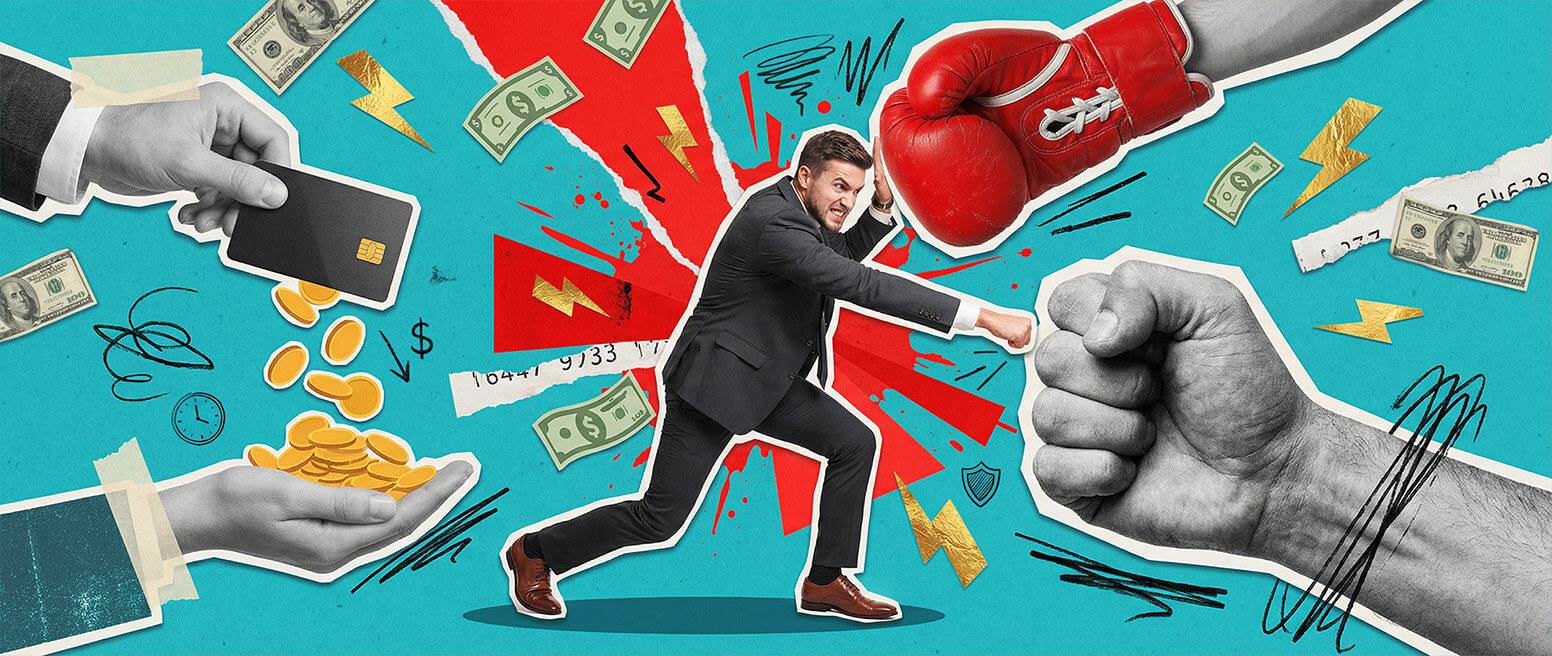
This featured video was created using artificial intelligence. The article, however, was written and edited by actual payment experts.
In a Nutshell
The credit card dispute process was designed to protect consumers. Unfortunately, that can sometimes feel like an unfair advantage to merchants. In this post, we explain the dispute process step-by-step, demonstrating what happens at each stage and providing action steps merchants can use to protect their business.
The Credit Card Dispute Process Guide for Cardholders & Merchants
Imagine this: You’re going through your accounts, preparing to pay vendor invoices and other such tasks. But, while looking at the books you suddenly realize you have less money in the bank than you thought… a lot less.
Your first thought is, “What the heck happened?!”
A closer inspection uncovers the truth: a customer filed a dispute, and the bank withdrew funds from your business without sending you any advance notice. The buyer never contacted you about a refund, so now you’re looking at a lost sale, an unhappy customer, and the real possibility of a permanent revenue loss.
It’s in your best interest to learn all you can about the dispute process. For instance, how does a credit card dispute work? And, what can you do about it? I’ll outline the basics below.
Common QuestionWhat is a credit card dispute?A credit card dispute, also known as a credit card chargeback, occurs when a customer disputes a transaction with their issuing bank. The bank files that disagreement on the cardholder’s behalf, overturning the sale, then claws the funds back from the merchant and returns them to the customer.
The credit card dispute process looks fairly convoluted from the merchant’s end. But, it’s a lot more straightforward for cardholders. Timelines and documentation requirements still apply, though.
A cardholder looking to file a typical credit card dispute will follow these steps:
#1 |
Contact the Issuer
If the dispute involves criminal fraud or identity theft, the cardholder should contact their issuing bank immediately to freeze their card and prevent further unauthorized activity.
#2 |
Submit the Dispute in Time
A cardholder can submit a dispute online, over the phone, or in writing. For the strongest legal protections, the cardholder should lodge a dispute within 60 days of the statement date on which the error appeared.
#3 |
Compile Transaction Details
An evidence-backed dispute is more compelling than a vague claim. The cardholder should have relevant documentation handy, like the transaction date, the precise dollar amount, the merchant’s name as it appears on the statement, and a clear explanation of the reason for the dispute.
The cardholder doesn’t have many responsibilities as part of the chargeback process. But, they’d be wise to maintain a paper trail of all dispute-related correspondence. This includes communications with the issuer, certified mail receipts, and any original receipts or emails related to the purchase.
During the investigation, the cardholder is not required to pay the disputed amount or related interest. In fact, they will typically receive a provisional credit for the amount under dispute. However, the cardholder is still responsible for paying the rest of the bill, including undisputed charges, by the due date.
When Can Consumers File Valid Credit Card Disputes?
There are both valid and invalid reasons for credit card disputes. Card networks like Visa and Mastercard publish lists of chargeback reason codes, which are essentially lists of acceptable triggers for legitimate disputes.
Broadly speaking, there are only a few valid reasons for disputing a transaction. The most common of these include:
Unauthorized Charges
This is the most common dispute reason that merchants will see. It applies when a third party uses the cardholder’s information to make a purchase without their knowledge or consent, which may happen, for instance, if the cardholder’s card number is leaked in a data breach.
Billing Errors
Merchant errors can trigger valid disputes. This includes scenarios where the merchant charges a customer for the wrong amount, submits a duplicate transaction for processing, or continues to charge a card even after a cardholder cancels a subscription.
Non-Delivery of Goods
If a customer pays for an item or service that they never receive, they have a valid reason to file a dispute. This applies to goods lost in transit, as well as services that were scheduled and paid for, but never provided by the merchant.
Significant Misrepresentation
A dispute is valid if the item received deviates substantially from what was advertised or listed on the merchant’s website. For example, if a buyer orders a luxury handbag, but when it arrives, the item is clearly a knock-off.
Important!
The cardholder must first make a good-faith attempt to resolve the issue with the merchant — for example, by asking for a replacement or refund — before filing a dispute with their issuer.
Invalid Reasons for Credit Card Disputes
There are a lot of “reasons” for chargebacks that fall outside of the scope of what we’d consider a “valid” reason. Illegitimate reasons for credit card disputes include:
Buyer’s Remorse
Changing one’s mind after a purchase doesn’t entitle the customer to file a dispute. If the merchant doesn’t accept returns, for instance, but the buyer knew that ahead of time and the product was delivered as described, then a chargeback would not be appropriate.
Forgotten Transactions
A cardholder can’t dispute a charge simply because they didn't remember they made a purchase. The same goes for a recurring subscription the cardholder forgot to cancel; the buyer has to try to cancel through the proper channels first.
Family Fraud
Purchases made by a family member or household member who had access to the card are generally considered authorized. If a child uses an adult’s card for in-app purchases, for example, the cardholder can’t claim the transaction was fraudulent.
Personal Preference
Say an item arrived exactly as described. But, the customer has a subjective complaint about it — he doesn’t like the color, fit, or style, for instance. The cardholder in question doesn’t have a valid reason for a dispute.
The process starts when a cardholder contests a transaction by contacting their issuer. I should also note that banks can file disputes without customer input, based on specific merchant errors, but this is less common. Generally, you can classify legitimate chargeback claims under a few basic categories: fraud, authorization errors, processing errors, or fulfillment errors.
Also, remember that each dispute claim is a separate case. Multiple disputed transactions mean multiple potential chargebacks may be filed.
Merchant Tip: You can preempt the need for a provisional credit by using one of several tools designed to prevent chargeback issuances. You have network inquiry tools, like Order Insight and Consumer Clarity, which let the issuer recall transaction information and resolve disputes without the need for a chargeback.
Step #2| Provisional Credit
Disputes can take several days, or even weeks to resolve. During that time, the funds in question will be tied up, and can’t be accessed by either you or the cardholder. So, the bank will typically issue a conditional refund to the cardholder.
The bank does a preliminary review of the cardholder’s claim. They just want to verify that the transaction happened, and that it was within the timeframe allowed under card network rules. If so, the bank will probably issue the temporary credit as a courtesy to ensure the cardholder has sufficient funds while the dispute is getting resolved.
Merchant Tip: You can preempt the need for a provisional credit by using one of several tools designed to prevent chargeback issuances. You have network inquiry tools, like Order Insight and Consumer Clarity, which let the issuer recall transaction information and resolve disputes without the need for a chargeback.
Step #3| Chargeback
The issuer checks out the cardholder’s claim. If it seems legitimate, they’ll attach a reason code to the case and send it along to your acquiring bank.
The issuer recoups their money from the acquirer, who will then debit the amount of the original transaction, along with applicable fees, from your account. These fees are meant to cover the acquirer's costs resulting from the chargeback, and are non-refundable.
Merchant Tip: Banks aren’t required to give you a heads-up before they pull funds from your account. Using the tools we mentioned above can help; if all else fails, you can deploy chargeback alerts, which give you advance notification of pending chargebacks and let you refund the buyer to avoid the claim. You can also use Rapid Dispute Resolution from Verifi. This lets you create preset rules to automatically refund buyers in the event of a pending chargeback.
Step #4| Merchant Reviews Claim
Along with the notification, your acquirer will give you some additional documentation about the transaction being disputed. You can review the chargeback documentation, and see if it makes sense.
If you agree with the buyer’s claim, you can respond that you accept the chargeback. In that case, the whole process ends here. But, if you think the claim is bogus, you can decide that you want to fight the dispute and try to recover your money.
Merchant Tip: Responding to all claims is a good overall strategy. Smaller transactions that might not seem worth the effort, and responding to chargebacks that you don’t plan to challenge anyway might seem like a waste of time. But, acknowledging that you at least received the chargeback shows that you’re engaged, which can improve your standing with banks.
Step #5| Representment
After gathering compelling evidence that proves the initial transaction was valid, you decide that the claim is not valid, and you want to fight it. This is done through a process called representment.
Basically, you re-submit the transaction to the bank, along with a body of evidence showing that the initial transaction was valid. You’ll also need to include supplemental documents, like a rebuttal letter.
Merchant Tip: Once you decide to challenge a claim, you’ll need to start immediately, as timelines for representment are tight and strict. Think about implementing an organized filing system that lets you locate transaction information quickly. That can greatly decrease your response time.
Step #6| Bank Review & Decisioning
The issuing bank reviews the new information then makes a decision. They might rule in your favor, and uphold the original transaction. Or, they might pursue one of two other options.
First, the bank may rule in favor of the cardholder, rejecting the additional evidence you provided. Or, in some cases, the bank might accept your response, but still file a second chargeback for a different reason. In the case of a Visa transaction, for example, you’ll get a pre-arb, which is like a message from the bank, rejecting your chargeback response.
Merchant Tip: It should go without saying that your case needs to be as airtight as possible to lower the odds of a second chargeback on the same transaction. Build your case around the reason code provided and the most compelling evidence you can find. Craft a concise, easy-to-read rebuttal letter that outlines your argument. Keep everything clean, clear, and professional.
If all the parties involved — you, the banks, and the cardholder — are unable to come to an agreement, then the associated card network (Visa, Mastercard, etc.) may step in. This is referred to as arbitration.
The card network will act as a neutral third party between all the different stakeholders. They’ll review the case, then issue a final ruling based on the language laid out in the card network’s rules. This decision can still be appealed, but it’s extremely expensive, and you’re unlikely to see a positive outcome.
Merchant Tip: It takes a lot of time, energy, and determination to get a case to the arbitration stage. There are also significant expenses involved, and a statistically small chance of winning. Unless the transaction represents a considerable amount of money, you’re typically better accepting a denied representment and moving on.
That’s a rough overview. But, I don’t want to give you the impression that dealing with disputes is a straight-forward, by-the-books process. It isn’t.
The entire system is based on decades of technology updates, rule changes, and increasingly-complex regulations. And, all of it is tacked on to a process created a half century ago. Strict credit card dispute time limits control each phase. Even attempts to simplify things often lead to unintended consequences and increased confusion.
A large part of the problem is a lack of standardization. Different card brands use different terminology, processes, and rules for different stages of the credit card dispute process.
Visa Credit Card Dispute Process
The life cycle of the Visa dispute underwent considerable changes with the adoption of Visa Claims Resolution back in 2018. The most significant changes were Visa’s overhaul of their chargeback reason code list and the introduction of the Allocation and Collaboration workflows.
When a customer files a dispute, the incident will be sent through the “Allocation” workflow if it is designated as a “Fraud” or “Authorization” -related dispute. It goes through a Collaboration workflow for other disputes.
Common QuestionAre disputes the same as refunds?No. There’s a big difference between the two, and it’s important that you understand the difference. With a refund, the customer deals directly with you to resolve the issue. The goods are returned, making it possible for you to resell them. Also, they can be processed immediately, and resolved in a few days.
With a chargeback, the customer bypasses you and goes straight to the bank. The customer has no incentive to return goods, and you lose the sale, the goods, & the overhead, plus pay chargeback fees. Plus, it can take weeks — or even months — to resolve.
Shifting from a reactive to a proactive stance can empower merchants to protect their revenue and chargeback ratios by stopping disputes before they occur. Dispute prevention tactics include:
Clear Billing Descriptors
Customer confusion can lead to (invalid) disputes. If your billing descriptor — the text that appears on a customer’s credit card statement — doesn’t match your “doing business as” name, customers may fail to recognize their purchase and assume it was unauthorized.
Visible Contact Information
If a customer has a problem, they should call you (not their bank). Make your contact information easy to find on your website, in emails, and on receipts. Burying contact details will result in frustrated customers, who may give up and reach out to their banks as a first (rather than last) resort.
Important!
Including a phone number as part of your billing descriptor may increase the chance that cardholders will give you a call before contacting their issuer to file a dispute.
Responsive Customer Service
Listing out your contact information is of no use if there’s no one on the other end of the line. A customer might attempt to contact you regarding a refund or error. Excellent, responsive service can help you resolve issues before they escalate to the issuer.
Transparent Policies
Surprises after checkout can trigger disputes. Beyond clearly displaying your return, refund, and cancellation policies at the point of sale, have buyers acknowledge your policies (via a checkbox) before they click “buy.” Doing so gives you evidence that you can leverage in representment, if necessary.
Order Confirmations
An immediate email confirmation upon purchase creates a paper trail and can reassure the customer that the order was received correctly. This can help quell anxiety and prevent premature disputes.
Trackable Shipping
If you sell physical goods, use carriers that provide tracking numbers and delivery confirmation. This keeps the customer informed during transit and can provide you with evidence to fight “non-receipt” disputes.
Subscription Notifications
Recurring billing is a high-risk area for disputes. Send a pre-billing notification email a week or two before a subscription renews, plus another follow-up notification just before the bill arrives. This reminds the customer of the charge and gives them a chance to cancel if they no longer want the service.
Chargeback Alerts
Merchants can intercept disputes by enrolling in chargeback alert services. These tools notify you when a dispute is filed, giving you a short window of time to pre-emptively refund the buyer and avoid the chargeback. You still lose the sale, but you won’t get hit with a chargeback fee, and it won’t impact your chargeback rate.
Order Insight & Consumer Clarity
Tools like Verifi Order Insight and Ethoca Consumer Clarity allow merchants to share detailed transaction data with issuers in real time. This can clarify a confusing charge for a cardholder and prevent them from filing a dispute out of confusion or a misplaced suspicion of fraud.
Automated Resolution Tools
Tools like Verifi’s Rapid Dispute Resolution (RDR) and Mastercom Collaboration allow merchants to set rules for automatically resolving certain types of customer disputes before they morph into chargebacks. This can help sellers streamline their operations, reduce manual work, and prevent damage to their chargeback ratios.
Know When to Ask for Help
There are several basic practices that might help you prevent disputes and lower your chargeback costs. Three of the most basic dispute-preventing moves that I’d recommend include:
Being a Customer Service Pro
Merchants can avoid many chargebacks by making it easier for customers to reach out to them. This means providing prompt, helpful responses to all phone, email, and social media inquiries and making sure your contact information is easily visible.
Pay Attention to the Details
Billing descriptors and other pertinent merchant information should be clearly identifiable to your customers. These are commonly overlooked dispute triggers, as cardholders may be unable to identify you by these indicators.
Be Up-Front About Merchant Policies
You should clearly present all information up-front. This is especially true for anything related to fees or charges that customers are likely to encounter. Tax, shipping and handling, and return policies should be recognizable to customers.
Every minute that you spend focused on credit card dispute resolution is time not spent serving customers and growing your business.
Fortunately, Chargebacks911® can provide a solution. Our tactical Chargeback Representment approach relies on a proprietary combination of machine learning and human oversight. The result: individualized, expertly-reviewed, and compiled cases, promising greater ROI and long-term chargeback reduction plans.
Don’t lose another dollar to a credit card dispute. Contact us today to learn more.
FAQs
Are credit card disputes usually successful?
Valid disputes, when filed correctly, are usually successful. “Valid” means the customer has a legitimate complaint they have already tried to resolve through the merchant. Keep in mind that the original claim may go through, even if the case is fraudulent. Those chargebacks may be successfully overturned through representment, though.
Do credit card companies actually investigate disputes?
Yes, banks investigate disputes. Credit card companies only get involved if the case makes it to the arbitration phase. Even then, the network may rely more heavily on existing evidence rather than launching a new investigation.
On what grounds can you dispute a credit card transaction?
Cardholders can legitimately file disputes on unauthorized use, such as fraudulent purchases. They can also file under what is called “merchant abuse.” This can be deliberate misconduct on the part of the merchant, such as charging customers unreasonably higher prices for using a credit card. Other scenarios, such as being unable to reach a merchant for a simple return, may also be grounds for a dispute.
How often do merchants win credit card disputes?
If an initial dispute is blatantly false, the bank may not allow the case to escalate to a chargeback. If a fraudulent claim does go through, the merchant may be able to successfully represent the case. Overall, however, the system is purposely set up to benefit the client, and therefore lowers the odds that a merchant will win the dispute.
What happens when a merchant loses a dispute?
The cardholder will get a full refund, including any related costs such as shipping or restocking. They have no incentive to return the item in question, so the merchant will likely also lose merchandise. Finally, the merchant will be charged an administrative fee by the bank. These chargeback fees are non-refundable, even if the merchant wins a reversal.
How do I make sure I win a credit card dispute?
For merchants, the key to winning a dispute is a well-crafted rebuttal letter, submitted along with compelling evidence that proves the validity of the original transaction. This rebuttal package must be submitted before the appropriate deadline.
Why wasn’t I notified before the bank took my money?
In some instances, issuers may claw money out of your merchant account first and only notify you after the fact. One reason for this is that the chargeback process is designed for rapid resolutions, at least from the perspective of the cardholder. The other reason is that chargeback notifications may take a while to go through, so you may see money leave your account before you receive a chargeback reason code.
Can I blacklist customers who dispute charges?
Yes. As a merchant, you have no obligation to do business with anyone. You’re free to blacklist customers who dispute charges, whether they’ve done so once or multiple times.
Be aware, however, that this might further upset customers, who’ll share their negative experience online, potentially leading to reputation problems.
Like What You're Reading?Join our newsletter and stay up to date on the latest in payments and eCommerce trends.
Newsletter Signup
We’ll run the numbers; You’ll see the savings.Stop losing money to chargebacks. Let us show you how much you could save.
Please share a few details and we'll connect with you!
Over 18,000 companies recovered revenue with products from Chargebacks911
Close Form
Embed code has been copied to clipboard
Embed this graphic
Copy the provided embed code for this graphic and then paste the code into the HTML portion of your website or blog article.